Frontier AI Risk Has Moved Beyond National Security to a Critical Strategic Dependency for the EU
This Should be the Concern of Every EU Politician and Policy Maker
On 12 June 2026, the U.S. administration, citing national security authorities, restricted foreign access to Anthropic’s most advanced AI models, Claude Fable 5 and Claude Mythos 5, including access by foreign nationals inside the United States and foreign national Anthropic employees. Because Anthropic could not immediately distinguish eligible from ineligible users, access was temporarily suspended more broadly while the company worked to comply.
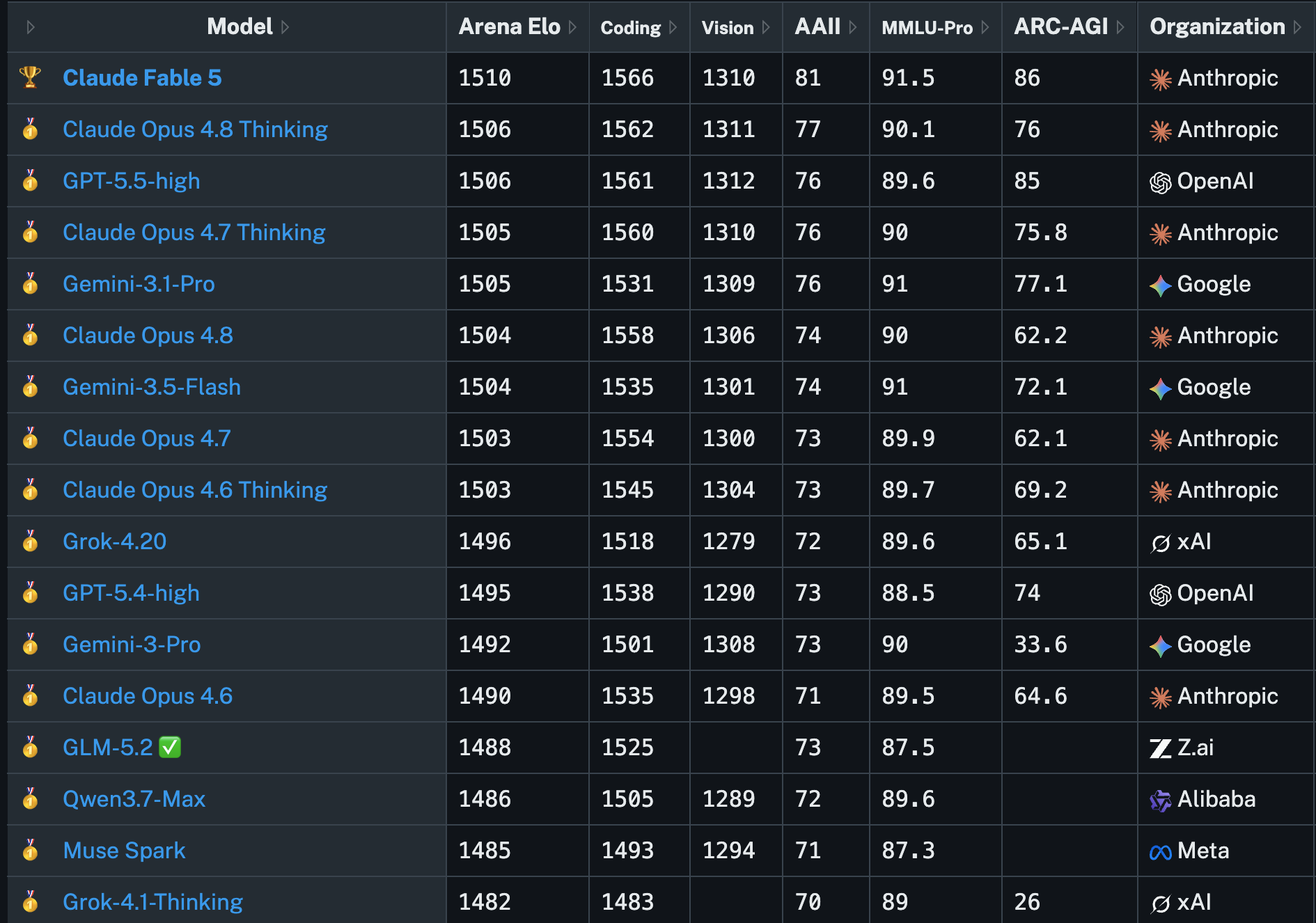
The world’s most advanced frontier AI models from the United States and China.
Whether those restrictions ultimately remain in place is almost beside the point.
The precedent has now been established.
Access to frontier artificial intelligence can become a geopolitical decision taken outside Europe, with direct consequences for European businesses, governments, researchers, and critical infrastructure, and has now become a potential instrument of geopolitical leverage.
For years, Europe has approached artificial intelligence primarily through the lenses of ethics, privacy, transparency, and regulation. Those discussions remain essential, but they are no longer sufficient. AI has evolved into something much larger. It is becoming a strategic capability that increasingly influences economic competitiveness, scientific leadership, cybersecurity, defence, industrial resilience, and geopolitical influence.
The events of 12 June did not create this reality. They simply made it impossible to ignore.
Frontier AI Has Become Critical Infrastructure
Artificial intelligence is no longer simply another digital technology. It is rapidly becoming strategic infrastructure.
Every major technological revolution has created a new layer of infrastructure upon which society increasingly depends. Electricity transformed industry. Telecommunications transformed communication. Semiconductors transformed computing. Cloud computing transformed the digital economy.
The same technology that malicious actors and nation states can use to identify and exploit vulnerabilities in critical infrastructure at unprecedented speed is also the technology we will increasingly depend upon to defend it. Security hardening, vulnerability discovery, software patching, threat detection, and cyber resilience are all moving towards machine speed.
The only way to defend against capable AI threat is with equally capable AI.
This is no longer a theoretical discussion.
Advanced AI systems are already accelerating scientific research, supporting pharmaceutical discovery, improving manufacturing, optimising supply chains, strengthening cybersecurity, and increasing productivity across virtually every sector of the economy. Countries that build these capabilities will shape the next generation of innovation. Countries that depend entirely on technologies developed elsewhere will inevitably have less influence over how those technologies evolve.
Artificial intelligence is therefore no longer simply an innovation policy issue. It has become a strategic capability.
Project Glasswing Offers a Glimpse of this reality
We are already seeing this transformation in practice.
In April 2026, Anthropic launched Project Glasswing, providing selected organisations with access to frontier AI capabilities to identify software vulnerabilities, harden critical systems, and strengthen cyber resilience before malicious actors could exploit those same weaknesses.
The founding partners included Amazon Web Services, Apple, Broadcom, Cisco, CrowdStrike, Google, JPMorgan Chase, the Linux Foundation, Microsoft, NVIDIA, and Palo Alto Networks.
There were no European companies among the partners.
This should not be interpreted as criticism of Anthropic. Rather, it illustrates how rapidly frontier AI is becoming a strategic asset. Organisations with privileged access to the world’s most capable AI systems will improve their resilience faster, accelerate research, strengthen innovation, and develop competitive advantages that become increasingly difficult for others to match.
The significance Extends Well Beyond Cyber Resilience.
Access to frontier AI increasingly influences scientific leadership, industrial competitiveness, research capability, and economic productivity. The countries helping to develop these systems will naturally influence their direction.
Countries that rely exclusively on capabilities developed elsewhere will have considerably less influence over the technologies that will shape their own economies. That should concern every European government.
𝗕𝘂𝘁 𝘁𝗵𝗶𝘀 𝗶𝘀 𝗻𝗼 𝗹𝗼𝗻𝗴𝗲𝗿 𝗼𝗻𝗹𝘆 𝗮𝗯𝗼𝘂𝘁 𝘀𝗮𝗳𝗲 𝗔𝗜. 𝗜𝘁 𝗶𝘀 𝗮𝗹𝘀𝗼 𝗮𝗯𝗼𝘂𝘁 𝗺𝗮𝗿𝗸𝗲𝘁 𝗮𝗰𝗰𝗲𝘀𝘀 𝗮𝗻𝗱 𝗴𝗮𝘁𝗲𝗸𝗲𝗲𝗽𝗶𝗻𝗴.
It is about technological leadership, scientific innovation, international trade, market resilience, information integrity, and Europe’s long term ability to compete globally. That should be the priority of every European policymaker.
An analysis published by the National Board of Trade Sweden in April describes that AI is becoming a system-transforming technology that is reshaping markets, information flows, and competitive dynamics. The report further explains that cumulative collective AI-driven societal risks fall. between existing EU regulatory frameworks, including the AI Act because of the reliance on an individual-harm regulatory paradigm. However cumulative collective societal risks – risks that do not necessarily qualify as traditional product defects or individual legal harm, may, due to their scale, acquire structural significance not only for citizens and consumers, but also for markets, competition, and trade.
Europe Has Seen This Pattern Before
The developments of June 2026 should not be viewed in isolation. Europe has seen this pattern before. Time and again, strategic dependencies have only been recognised after they became strategic vulnerabilities.
We saw it with energy.
We saw it with semiconductors.
We saw it with defence.
Today, we are seeing the same pattern emerge with frontier artificial intelligence.
The difference this time is speed.
Energy transitions unfold over decades. Defence capabilities require years to build. Semiconductor supply chains take enormous investment and time to establish. Frontier AI is moving at the speed of weeks.
While Europe debates regulatory frameworks, other regions continue building models, attracting talent, securing computational infrastructure, and investing hundreds of billions into the next generation of AI capabilities.
This is not an argument against regulation.
It is an argument that regulation alone is no longer enough.

Geoffrey Hinton’s Nobel Prize in Physics 2024 Banquet Speech. One of the most important contributors to modern AI now warning about its risks. Credit: © Nobel Prize Outreach 2024. Production: SVT
Geoffrey Hinton Warned Us
Europe has already recognised the scientific significance of artificial intelligence. In 2024, the Royal Swedish Academy of Sciences awarded the Nobel Prize in Physics to Geoffrey Hinton for the foundational discoveries and inventions that enabled machine learning through artificial neural networks.
“The rapid progress in AI comes with many short-term risks. It has already created divisive echo chambers by offering people content that makes them indignant. It is already being used by authoritarian governments for mass surveillance and by cybercriminals to increase the scale and sophistication of phishing attacks. In the near future, AI may accelerate the development of biological threats and enable increasingly autonomous weapons systems with reduced human oversight.
All of these short-term risks require urgent and coordinated attention from governments and international organizations. There is also a longer-term existential threat.”
Given the latest events from 12 June, these warnings should now also be viewed through another lens: strategic sovereignty.
As artificial intelligence becomes central to economic growth, scientific leadership, cybersecurity, defence, and national resilience, the gap between technological capability and institutional preparedness is no longer only a safety challenge. It is a strategic challenge. As artificial intelligence becomes central to economic growth, scientific leadership, cybersecurity, defence, and national resilience, the gap between technological capability and institutional preparedness is no longer only a safety challenge. It is a strategic challenge.
Europe Already Recognises AI as Strategic
Interestingly, Europe has already acknowledged much of this itself.
Following growing geopolitical instability and renewed concerns regarding Europe’s security, the European Union launched the Readiness 2030 initiative to strengthen Europe’s defence capabilities and strategic autonomy. Artificial intelligence is explicitly recognised as one of the strategic capability areas necessary for Europe’s future resilience, alongside air defence, cyber capabilities, space technologies, drones, and advanced defence systems.
The recognition is there.
The urgency is not.
If artificial intelligence is already considered a strategic capability for Europe’s defence, it should also be considered a strategic capability for Europe’s economy, research ecosystem, industrial competitiveness, and technological independence.
These discussions should no longer be confined to technology ministries. They belong equally within ministries of finance, trade, defence, industry, education, and the offices of Europe’s prime ministers and heads of government.
Artificial intelligence has become a whole-of-government issue.
Regulation Alone Will Not Create Sovereignty
Trustworthy AI remains one of Europe’s greatest strengths. However, regulation without capability cannot create sovereignty.
Europe risks becoming increasingly dependent on technologies that it neither develops nor controls. No amount of regulation can fully compensate for strategic dependency.
A continent that relies on frontier AI systems, cloud infrastructure, semiconductor manufacturing, and investment originating elsewhere will inevitably possess less influence over the technologies shaping its economy and society.
Regulation builds trust. Capability creates sovereignty. Europe needs both.
The Race for AI Dominance
European researchers continue producing world-class science, and its entrepreneurs continue founding exceptional companies. Yet many of those companies scale elsewhere because capital is easier to access, infrastructure is more readily available, procurement is faster, and investment decisions are made with greater urgency.
Too often, European founders spend months navigating fragmented funding mechanisms and complex administrative processes while competitors elsewhere spend the same time building products, recruiting engineers, and serving customers.
Our bureaucracy itself has become a competitive disadvantage. This is not simply an innovation problem; it is becoming an economic security problem.
Building Capability Must Become a Strategic Priority Europe should not respond by abandoning regulation. Nor should it attempt to imitate every aspect of the American or Chinese AI ecosystem. Europe should build on its own strengths while addressing its structural weaknesses.
As mentioned earlier, investing significantly in sovereign computational infrastructure, accelerating frontier AI research, strengthening European AI companies, expanding access to growth-stage capital, and creating conditions that allow European innovation to scale within Europe rather than leaving it.
Investment decisions need to move at the pace in which frontier AI evolves. Therefore, the question is no longer whether Europe can afford to invest. The question is whether Europe can afford not to.
Artificial intelligence has become an infrastructural dependency on a global scale.
Countries that lead in AI will increasingly shape global standards, attract talent, influence investment, and determine the pace of technological progress.
Countries that do not will increasingly depend on those that do.
Why I Intend to Become More Active in Swedish and EU Politics


I believe Europe needs more people with practical experience in artificial intelligence, cybersecurity, business, digital resilience, and strategic risk helping shape public policy and political decision-making.
These conversations can no longer remain inside data protection and AI conferences. They belong in our parliaments, our government, and at the centre of Europe’s political agenda.
For that reason, I aim to become more active in the Swedish political landscape alongside my professional work. I am willing to put in the extra hours because I strongly believe that Sweden and Europe need stronger hands-on leadership on artificial intelligence, technological sovereignty, cybersecurity, economic competitiveness, and digital resilience.
If representatives from Swedish political parties, Members of the European Parliament, government institutions, public authorities, or organisations working within these areas believe these perspectives could contribute to their work, I would genuinely welcome a conversation. Feel free to reach out directly to Hummam@Art25consulting.com
Artificial intelligence will shape Europe’s future regardless of what we do.
The real question is whether Europe intends to shape that future itself, or take the opportunity to lead it.